The Dragonologist
How Sken Got His Name

Morg, Dragonologist for the King in The Circus Dragon's world
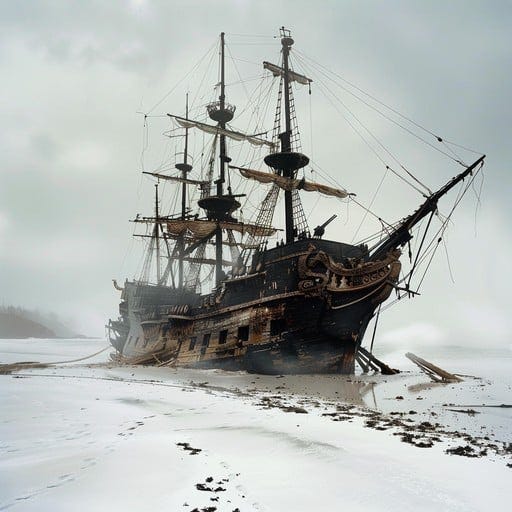
The Uncounted Dimensions hold many things. One of them is death.
Some time after the Wars, a lone pirate ship sailed into the Uncounteds by accident during a storm, reappearing months later. Its wild-eyed crew paid in strange coin. They raved about vast, unguarded hoards. Rumors spread, port to port and ship to ship. Many more pirates chased the evolving stories.
But as rich as the legends were in treasure, they were tragically short on clarity as to the pitfalls of navigating shifting, overlapping dimensions with few reliable reference points. Of all the ships that went in search, barely a handful returned. Those who did not return did not survive.
I learned to navigate the Uncounteds while searching for Dragonsign, tracking and locating the Dragons who live there. Naturally, one excellent place to look for Dragonsign is at the wreck of a pirate ship. Any passing Dragon would be interested in the shinies that might be on board.
Thus, I encountered a great deal of death.
When I began my field research, it seemed to me the hoard hunters and scrappers took it in stride that ships full of skeletons, desiccated corpses, and human remains at other levels of decay are common sights for those who seek the Uncounteds’ treasure. Most scavengers just shrugged when I talked about all the death.
I did notice they abruptly clammed up when certain wrecks were mentioned. Conversely, wild stories were repeated by those who loved to repeat wild stories. I learned from experience whom to heed and whom to thank for the entertainment. At other times, when a scav shared a clue about a wreck “somebody heard something about,” it was irritatingly obvious that they knew more than they were telling me. Any such group rightly tests the mettle of newcomers, though I didn’t understand that at the time.
I found it impossible to shrug off what I encountered. The sights haunted my sleep, as if the pirates who had died were calling for release. But one could spend a lifetime going from wreck to wreck to bury or burn the remains. To identify even one sailor would have required travel and research hours. What to do to honor these souls and bless their safe passage?
I took to reading aloud the name of every ship I found, with the conscious intention of releasing the spirits of the crew and sending them on their way. It was a small gesture, I told myself, perhaps only a personal coping mechanism as I journeyed alone through the shiftings.
But I felt better after I started reading out ships’ names. My research alongside the dead felt somehow less intrusive. There were no more eerie noises or spooky chills. The nightmares stopped, so I had a clearer head.
The Uncounteds being as they are, my actions had a reverberating impact that I could never have anticipated.
Word got out about my little ritual. The scavs asked me point blank what I was doing out there. They valued the undeniably peaceful difference when they picked wrecks I had marked.
Far from mocking me as I had feared, they began to bring me real stories and locations of ships “…too haunted to pick. Will you go handle it, Morg?” They told of dancing lights, weird sounds, wrecks that suddenly collapsed all at once, ghosts that stuck to the soles of their boots, and all manner of Uncounted madness.
By “handling” these wrecks, I got to check for Dragonsign at undisturbed sites, with the scavs’ full cooperation. I got to honor and release any spirits who were stuck there. And I got First Hand.
Once someone marks First Hand on a site, nobody else touches a thing until the First marks that they’re done. At that point, the site is, in a sense, mapped. It becomes far easier to navigate to, and anyone can go and pick whatever’s left.
My tough and stoic associates were so rattled by the pirate ghosts and their shenanigans that they were happy to trade away their own First Hand picks in order to have me clear the spirits from the wrecks.
This worked as well as it did for all of us because my First takes focused on items of historic and cultural value, while I left much (definitely not all!) of the coinage and ingot for those who followed. They thought I was crazy, their practice being the exact opposite. But it won me their delighted goodwill, a stream of fresh leads, access to clean wrecks, and enough First Hand treasure to fund decades of research while accumulating a massive hoard.
One morning in the dead of winter, I bundled up and set out to locate the latest reported “haunt,” a ship that emanated such “gawdawful screaming shrieks” that the hardened scrapper who’d found it had immediately shifted right back out. “I spit me beard!” he exclaimed, his eyes wide and horrified.
I chose to assume that further details regarding his beard incident would not be relevant to my search for Dragonsign.
Upon locating the wreck, I moved to the bow, where the ship’s name was painted high on her side. Schenechtady.
What language was this?! I couldn’t imagine plugging “ch” sounds into that mess. Maybe hard “k’s” instead? I hoped that if I mispronounced the ship’s name, any spirits on board would still receive my intention in good faith, and have a chuckle at my expense on their way out. Surely the ship had provoked such confusion anywhere she docked.
I began to speak her name: “Schen--” and immediately realized how long it had been since I last used my voice. My throat seized up in the cold. As I coughed to clear it, I heard a strange, weak hiss inside the wreck.
“Sk...sk...sken...skensk….” it continued on after my cough.
The hairs on my arm bristled beneath my warm layers. It was faint, but that wasn’t a ghostly voice. Was it? Somehow, I could hear that it came from a body with lungs. But who? I must be wrong. The crew was long dead. There was no sign of life. It did look as if some carrion birds had been through not long ago. Were they scared off like the bearded scav?
“Ssssskennnnnn.…” entreated the voice in a rasp.
“Schenechtady.” I replied firmly. Let all spirits freely pass on, I added silently, and with extra fervor.
“Sk sk sssssskennnsk.…”
Ok, that was definitely a voice in a body! I leapt onto the deck and moved aft toward the sound, scanning the boat for signs of anything not dead.
“Sken....Sken....Sk.” A juvenile raven was lying belly-down at the back of the deck, shivering in the snow, his head bobbing as he tried weakly to raise it to speak. He was clearly dehydrated and starving.
“What are you doing here?” I murmured as I knelt beside him, using gentle movements and indirect eyes to show intent to help and not to harm. As he tried to stand and then collapsed back onto the deck, I saw that one of his feet was caught between two boards.
“Oh! I see. Let me help.”
To this day, I have no idea how he got his foot so thoroughly stuck. I was sure I was going to damage his slender bones before I figured out how to dislodge him. He laid still except for a fading shiver, his feathers icy-cold in my left hand as I held him just off the deck to get to his foot underneath. His head rested against my hand as if he had used his last strength to call to me. I struggled for a bit, one-handed, and wondered if the bird would die waiting after all. Finally, using my knife, I carefully pried away a small piece of wood and was able to work his foot free.
Cupping the raven in both hands, I lifted him from the deck. He was motionless. He had closed his eyes. I wondered if there was any heat left in his body. I wondered again if I was too late.
I remembered reading about how birds in crisis or shock are greatly assisted by proximity to the human heart. Something about the heart’s powerful electromagnetic field, which extends several feet around the body.
I took a huge inhale, breathing long and deep into the bird’s chest feathers to warm his body, then laid him on my lap. He didn’t move as I shoved my scarf down through my coat, tying it into a sling around my torso. Then I carefully picked him back up, breathed heat into him again, and wrapped him in the scarf sling so that he was held securely against my heart. I closed my coat around him with only his head exposed. I could feel him trembling faintly against me. He was still alive.
Using a finger, I dribbled some water from my flask into the side of his beak. He opened his eyes and swallowed. I wondered if it was enough to help. How much should I give him? I had no idea. He was so weak. I pinched a bit of bread from the dayloaf in my bag. He took it from my fingers carefully, gently, and then gulped it down violently. He accepted more water dribbled from my finger. And more. Then with a small shaky sigh, he dropped his head against my chest. I adjusted the scarf to support his head.
Quickly, I made my First Hand mark at the ship’s name before leaving. By the time I got back to my cave, the bird’s shivering had stopped. I wondered if he was sleeping in my scarf, or lying there dead beside my heart.
As you know, he was asleep.
After a few days’ rest by the fire, feeding on broth and then meat, the young raven began to perk up. Fortunately, his leg and foot had sustained no lasting damage. By the end of a week, when he wasn’t asleep, he was following me everywhere, examining everything I owned.
The entire first month, all he said was “sk” and “Sken.” It was his “yes,” his “please” and his “thank you.” He was very thankful.
I surmised that the scav must have heard the bird screaming shortly after he became trapped, when he still had strength. It is a fearfully loud sound, and would be easy to misinterpret if one were half-expecting spooky strangeness.
When the bird heard my voice catch on that first syllable of “Schenechtady,” I guess he knew he was saved. In that moment, it seems those sounds became his treasured favorites, apparently for life.
Ravens don’t usually name their young until they survive to adulthood. As juveniles mature, a consensus arises among the Nest members as to what to call them, based on appearance, habits, skills and/or personality traits. The raven is officially Named and recognized as an adult member of the Nest when one of the Elders, the senior mated pair, addresses them by this moniker or some other of the Elder’s choosing. A Naming is a very loud and celebratory occasion.
The little guy just had me. That’s a very tender wound, to be abandoned by your own. He was deeply affected by whatever experience caused his Nest to leave him. He woke up cawing, screaming, every night for the first six months he was with me. I know from his desperate need for comfort that he was dreaming of being left alone on that ship.
I didn’t learn about raven Naming until later, so in the beginning I assumed he must already have a name.
I could tell he understood when I taught him my name. He most often (still) calls me “SkMorgsk” in affection.
But even then, when I asked him what his name was, all he answered was, “Sken?”
Finally, I gave up on ever getting a different response out of him. I said, “So that’s your name now? No matter what it was before? Are you Sken?”
In the ensuing minutes of excited squawking and flapping and “SKENSKSKSKSK” and hopping and head bobbing and bowing, interspersed with several tender but very intense raven-hugs, I gathered that he was good with it.
Later, coming to understand raven Naming as a rite of passage and a ritual of acknowledgement, acceptance and belonging given by an Elder, I saw the deeper context of Sken's response. In Naming him, I was re-Nesting him. In acknowledging his love for that syllable, Sken, I affirmed his survival of all that had preceded it. He received raven ritual assurance that now he belongs with me.
And that’s how Sken got his name.
Whomever and whatever he loves, Sken puts a “sk” on it.
Sometimes he also uses “sk” when swearing. I think it’s about adding emotional punch. But there’s quite an obvious difference in tone between “SkMorgsk” (I love you) and “SkMorgsk” (I really don’t want to listen to you)!
Thank the gods my throat was froggy and I didn’t manage the ship’s whole name on the first try. Otherwise, I might have a raven named Schenechtady, and who knows what he’d be calling his loved ones?
Sksksk ♥️ loved this
Ohhhh this is so gorgeous Morgan, I truly loved it.